
A long time ago, I read something in Osho’s book Intimacy about the difference between a reaction and a response. He said:
A reaction comes from the past.
A response comes from the present moment.
A reaction is an old pattern. Someone insults you, and without even noticing, the old mechanism turns on. Maybe in the past, whenever someone insulted you, you responded in a particular way. And now, you repeat the same pattern again. You’re not actually responding to this person or this moment—you’re repeating history. You don’t sense the unique flavour of the present. You just go into “autopilot,” like a robot. Something triggers you, and you think, “He insulted me,” and the whole pattern runs. But the truth is, your reaction has nothing to do with what’s really happening. It’s a projection—a shadow of something unresolved inside you.
Recently, certain experiences in my own life helped me really feel the difference between reaction and response. Not as a concept, but as something alive. So I want to share a story here and invite you to feel into it with me.
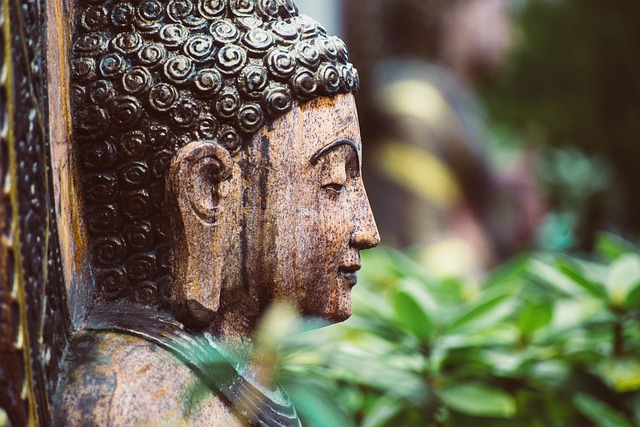
The Story of the Buddha
One day, the Buddha was sitting under a tree, teaching his students. Suddenly, a man walked up and spat in his face.
The Buddha calmly wiped the saliva away and asked him,
“What next? What do you want to say now?”
The man froze.
He had never experienced such a thing.
Whenever he insulted others, people always reacted—anger, fear, pleading, something.
But the Buddha did neither.
He wasn’t offended, he wasn’t afraid and showing weakness.
He simply stayed with what is:
“What next?”
To him, the past didn’t exist in that moment. There was only this breath, this presence.
But the Buddha’s disciples were furious.
Ananda, his closest disciple, said,
“This is too much. This man cannot get away with this. You continue your teaching—let us punish him.”
The Buddha said,
“Calm down. He didn’t anger me.
But you angered me.
This man is new. He knows nothing of me. He must have heard something from others—maybe that I’m a non-believer, a corrupter, a troublemaker. He wasn’t spitting at me; he was spitting at his own idea of me. He doesn’t yet know who I am. How can someone spit on a person he does not know?”
He continued,
“If you look deeply, you’ll see he was really spitting on his own mind. I’m not part of that mind. And I could feel that he had something he needed to express. Sometimes when we can’t find words—when we’re angry, overwhelmed, hurt—our emotions spill out through actions. Spitting was his way of expressing something unspeakable. That’s why I asked him, ‘What next?’”
The man went home in shock.
His entire world was shaken.
He couldn’t sleep. His mind kept spinning, sweating, trembling. Nothing in his life had prepared him for such a response. Something in him had cracked open.
The next morning, he came back.
He bowed at the Buddha’s feet.
The Buddha said gently,
“And now? This gesture, too, is an expression. When something is too deep for words, the body speaks.”
The man said,
“Please forgive what I did yesterday.”
The Buddha answered,
“Forgive? How can I forgive you?
The person you spat on is no longer here.
The river has already flowed on.
And you—you’re not the same man as yesterday either. Yesterday you were full of anger. Today you bow with reverence. How can these be the same two people?
Let those two disappear.
They no longer exist.
Let us speak of something else.”
This is response—awake, conscious, alive in the present moment.
Reaction is the Past. Response is Presence.
When we respond from old patterns, we are not truly here.
We are living as the past version of ourselves, replaying old wounds, old habits.
A response, however, is grounded in awareness.
It comes from this breath, this moment, this reality—not from yesterday.
Most of our life, maybe 99%, is reaction.
Only once in a while does a true response arise.
But when it does, a door to the unknown opens.
Old Conditioning is Anti-Life
Sometimes I feel that strong ideologies, traumas, and old habitual patterns are all forms of reaction—they belong to the past. They make us rigid. And life is never rigid. Life is movement. Life is the river that never stays the same.
In the I Ching, the essence of life is change.
The only constant is change.
But our conditioning is dead, unmoving.
When we meet the ever-changing present with our dead old patterns, life cannot flow. We become stuck, lifeless—“buried in a grave while still alive,” as Osho said.
To break free from our habitual reactions requires ongoing practice.
It requires courage to let go of what no longer serves us,
the willingness to release old identities,
and the clarity to recognize what truly belongs to us and what doesn’t—to practice clear boundary consciousness.
It’s not easy.
But every time we choose presence over past, something in us becomes free.


 Family Constellation | Shamanic Healing with Mira Chen
Leave a comment